
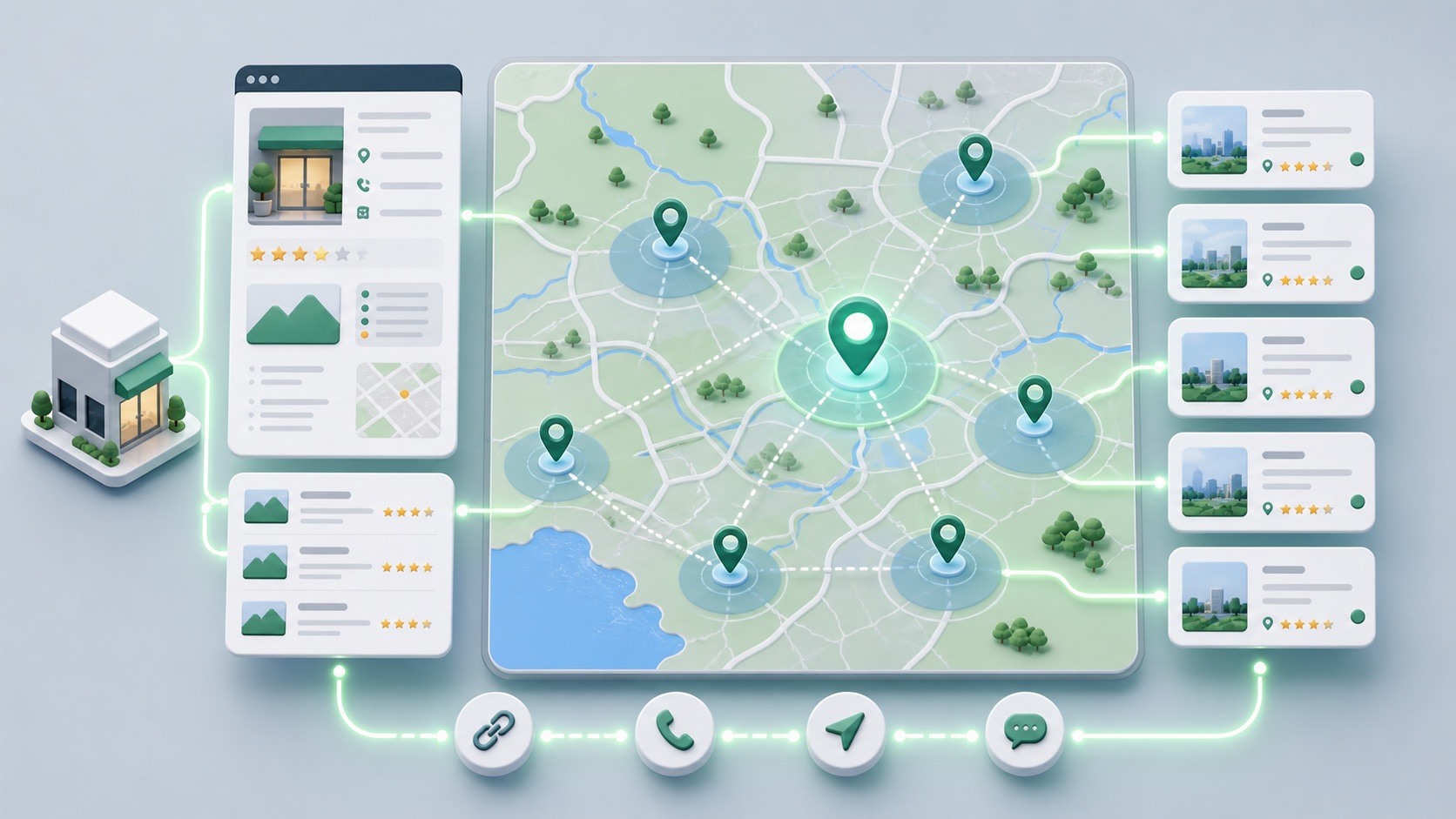
 AI-generated illustration
Scale Local Landing Pages: Become Visible Without Building Doorway PagesHow Location Pages Deliver Real Local Benefits
Scale local landing pages for SEO: search intention, location signals, content, internal links, Google company profile and quality.
Local landing pages only work if they provide real relevance per location - not if city name and standard text are exchanged.
Classification and SEO relevance
The article helps companies with multiple locations or catchments to cleanly plan and scale local pages.
Local searches have high proximity to action. At the same time, Google is increasingly recognizing duenne doorway patterns. Whoever scales local pages must therefore deliver local substance, clear performance, real contact paths and consistent data.
Control case: A place name is exchanged without own offer
Ten pages describe the same service and only exchange the city. Check which locations are actually served and which demonstrable differences exist, such as travel, contact persons or local project examples. Do not invent branches to justify pages.
If there is no independent information, a good performance page with an honest description of the area can make more sense. For real locations, each page needs correct contact information and a process that matches the location.
Recommended approach
- Separate real locations, catchment areas and purely informative location examples.
- Define search intention, performance, contact route and local receipts per page.
- Create reusable templates, but fill them with real local information.
- Link local pages about location reviews, service pages and relevant specialist articles.
- Measure rankings, calls, routes, forms, and local conversion signals per location.
Typical errors
- Use the same text with exchanged place name
- Mixing sites and catchment areas
- Do not establish a clear connection to Google’s company profile
- local pages do not link in navigation or hub
- Discuss ratings, contact and performance inconsistently
Practice checklist
- Is there real performance or real presence for the place?
- Are the name, address, telephone and opening hours consistent?
- Does the site have local examples, reviews or contacts?
- Is it internally findable and not only hidden in the sitemap?
- Does the Google company profile fit the landing page?
- Are duplicate or doorway-like patterns avoided?
How to identify improvements
- Local rankings by city and performance
- Clicks on phone, route and contact
- Visibility of local registers
- Indexing of Local Pages
- Conversion rate per site page
Related Articles and Next Meaningful Steps
Frequent questions
Are many city sites risky?
Yes, if they do not offer their own local benefit. With real location signals and relevant information, they can make sense.
Does every place need its own side?
Only if there is search demand, performance and local relevance.
Which is more important: local page or Google company profile?
Both. Profile and landing page should work together consistently.
Conclusion
Scale only demonstrable local information. Many similar sites without their own use can deteriorate the orientation and should not be created for the mere interception of combinations of locations.