
Consent behaviour
Tracking should only become active when the necessary consent is available.
Analytics tracking touches on data protection, technology and trust. It is important whether integration, consent, hints and actual scripts fit together.
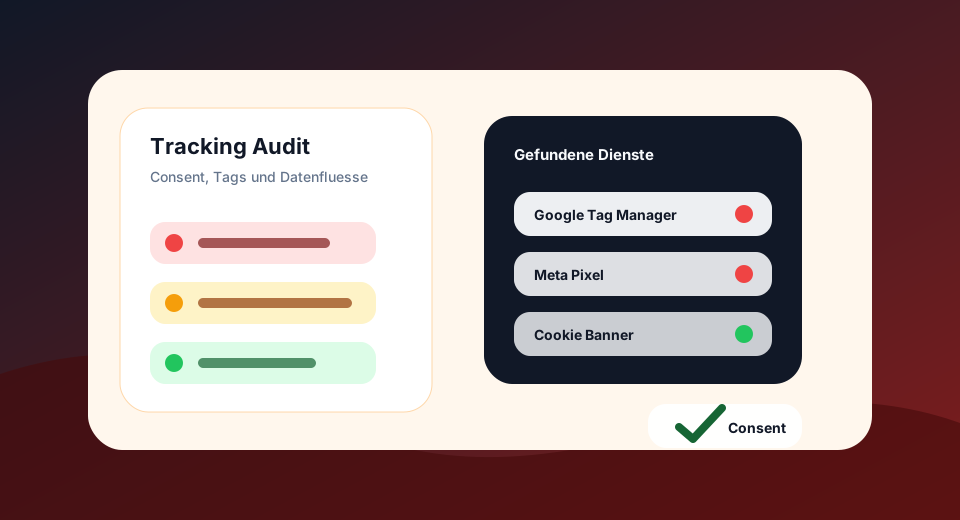
Whether Google Analytics is used GDPR-compliant does not depend solely on the visible banner. Relevant are actual scripts, consent behavior, cookies, data protection notices and technical triggering.
Seitenreport cannot replace legal advice, but it helps to make technical anomalies visible and ask the right questions for further examination.
Tracking should only become active when the necessary consent is available.
Actually loaded tracking scripts and set cookies must fit the data protection declaration.
An audit helps to find hidden or forgotten integrations on individual page types.
Google Analytics is not just about whether a tool is installed. Relevant is when scripts are loaded, whether Consent is respected, which cookies are created, which hints are present and whether old tracking residues are still in the source code or tag manager.
A technical examination cannot replace legal advice, but it can make visible where contradictions arise. It is precisely these contradictions that are often the starting point for data protection and trust problems in practice.
Tracking is often integrated across multiple layers: CMS plugin, theme, tag manager, consent tool, old templates or external widgets. This can create a setup that was originally intended to be clean, but no longer works consistently after updates or relaunches.
Especially critical are dual integrations and scripts that load before consent. Data protection notices can also become obsolete if services are changed or additional marketing tools are added.
Technical anomalies should first be documented and prioritized. After that, it can be decided whether the implementation is in the CMS, in the Tag Manager, in the Consent tool or in the data protection declaration. For legal evaluation, specialised advice makes sense in the event of uncertainty.
The advantage of an audit: It provides specific URLs, services and signals. This turns an abstract data protection question into a verifiable technical task list.
A company can believe that it has integrated Google Analytics cleanly because there is a consent banner. Technically, however, something else can happen: The Tag Manager already loads before consent, a plugin sets additional cookies or an old tracking code is still in the template.
A technical examination helps to find these cases. It shows which scripts and services appear on which page types and whether visible hints, actual integration and expected behavior match.
The assessment of whether this is legally sufficient in the specific case then belongs in expert hands. Seitenreport consciously positions itself here as a preliminary examination and documentation aid, not as a substitute for legal advice.
This makes the site sustainable for SEO and conversion: it serves the specific search query “Google Analytics GDPR”, remains serious and leads to the website audit as a technical basis.
When it comes to Google Analytics and GDPR, transparency is crucial. Businesses need to know which services are technically loading, when they’re loading, and whether visible clues match the actual website.
The site deliberately formulates this benefit cautiously. It does not promise legal approval, but a better technical basis for internal clarification, data protection checks or subsequent specialist advice.
This keeps the expectation clean: Seitenreport finds technical anomalies, the legal assessment remains a subsequent step.
No. Seitenreport provides technical advice and test points, but does not replace individual legal advice.
Because it has to be checked whether the actual technical triggering of the scripts fits the banner and the consent.
Yes, technical anomalies such as external scripts, cookies, data protection notices and integrated services can be made visible.
No. Seitenreport can provide technical advice. A legal assessment should be carried out by qualified data protection or legal advice.
Because it makes specific deviations visible, such as tracking before consent, duplicate scripts or services that do not fit the data protection notices.