
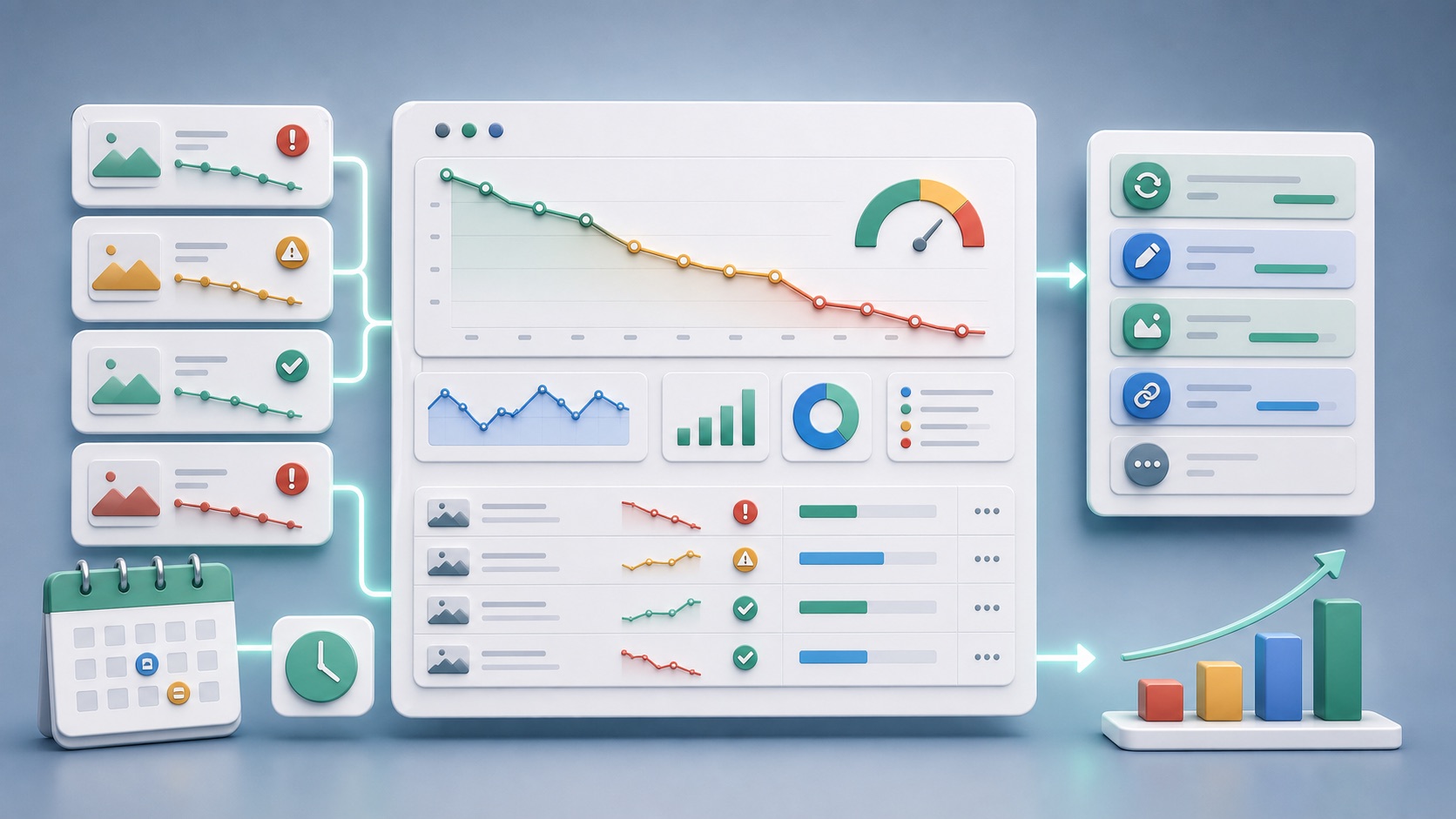
 AI-generated illustration
Recognize content decay: when good articles slowly lose visibilityMonitoring, root cause analysis and refresh prioritization for grown knowledge bases
Detect and fix content decay in SEO: Search console signals, ranking losses, outdated content, refresh priorities, and internal links.
Content decay is often not a sudden crash, but a slow loss of relevance, updating and internal priority.
Classification and SEO relevance
The article helps teams identify and specifically update ageing content early on before rankings, clicks, and leads drop significantly.
Many articles work well after publication and then become creeping weaker. Competitors update, search intentions change, snippets lose traction or internal links migrate to newer pages. Without monitoring, this often only occurs when the traffic is already gone.
Control Case: Season or Outdated Content?
A garden guide loses clicks in October. Compare the same section of the previous year’s season, relevant searches and similar unchanged pages. If the entire topic falls, the decline cannot be attributed solely to the age of this article.
If, on the other hand, so far strong requests lose positions with comparable demand, check outdated information and missing answers. Log the specific change and re-evaluate the same request/page section.
Recommended approach
- Create a list of URLs with declining clicks, impressions, or positions over several weeks.
- Separate season, technical issues, SERP changes and content aging.
- Prioritize pages by early performance, search intention, and conversion approach.
- Update statement, examples, structure, title, internal links and connection offers together.
- Compare the development four to eight weeks after the refresh at the query level.
Typical errors
- all traffic losses flat-rate with new texts
- Confuse Seasonal Fluctuations with Real Decay
- Update old articles, although they should be consolidated
- forget internal links and snippets during refresh
- do not plan a success check after the update
Practice checklist
- Is the return course visible over a reasonable period of time?
- Are affected queries and page types clearly separated?
- Are facts, screenshots, recommendations and examples still current?
- Are there new competitors with better search intentions?
- Are internal links to and from the site still strong enough?
- Has it been decided: refresh, reconciliation, new article or removal?
How to identify improvements
- Click and Impression Trend per URL
- Query loss by topic cluster
- Number of Updated Top Articles
- Recovery of CTR and Position
- Leads or follow-up clicks after refresh
Related Articles and Next Meaningful Steps
Frequent questions
When do you talk about content decay?
If a previously strong page loses visibility, clicks or relevance over several weeks or months and the return is not only seasonal.
Should you simply update the date?
No. The date should only be changed if the content has really been revised.
Is a new article better than a refresh?
Only if search intention or topic have changed so much that the old URL no longer fulfills the task cleanly.
Conclusion
Update content based on occupied gaps, not a blanket calendar. Distinguish demand, visibility, and click-through rate before classifying a refresh as successful or ineffective.