
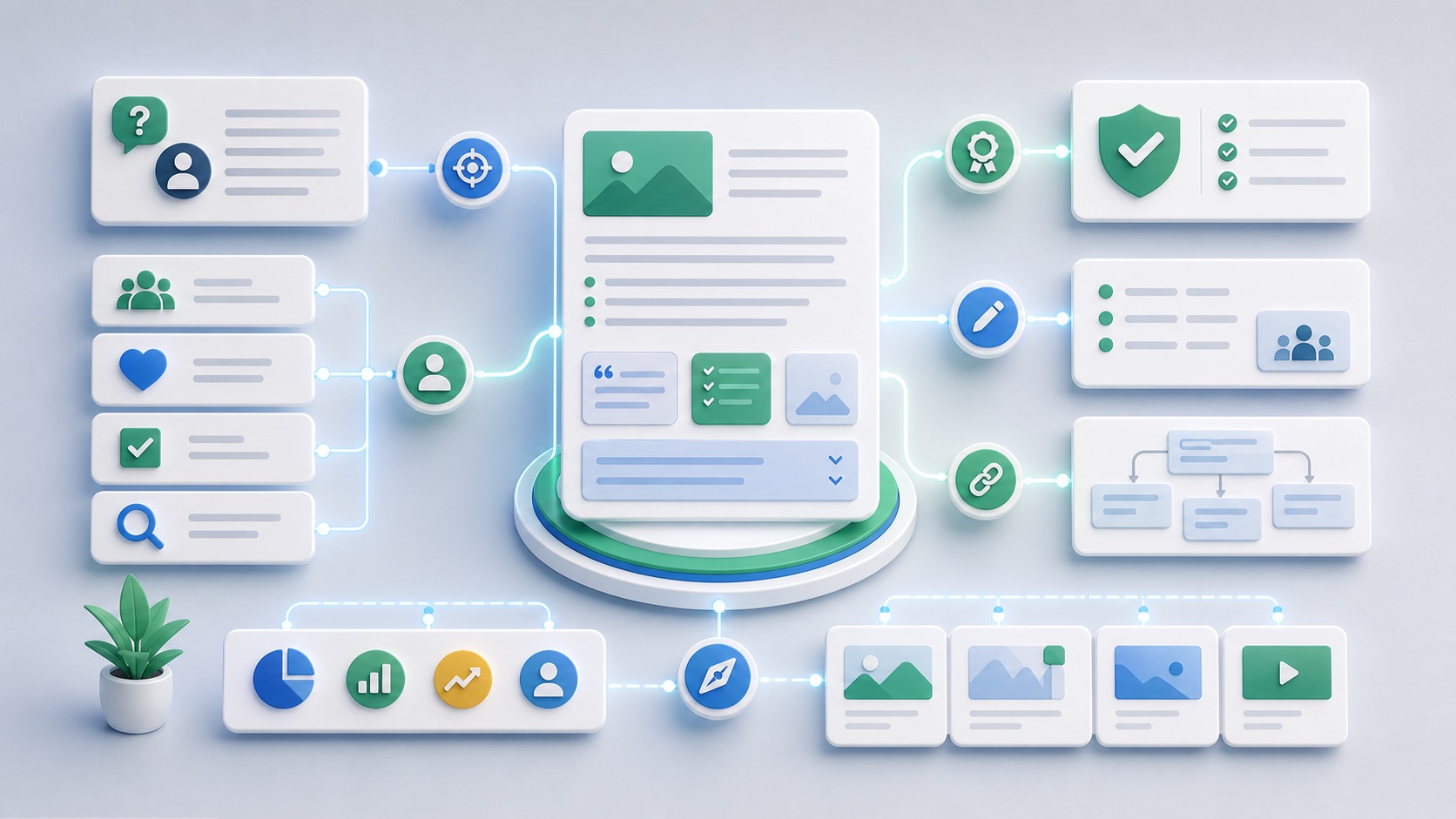
 AI-generated illustration
Helpful content for Google: People-first instead of search engine theaterHow Content Gets Really Nutritious and Still Achieves SEO Goals
Helpful content according to Google logic: search intention, own experience, clear structure, up-to-date and measurable user tasks instead of keyword theater.
Helpful content arises when a page solves a specific user task better than interchangeable summaries.
Classification and SEO relevance
The article shows how editorial teams and SEO teams can plan, review, and improve content without sticking to rigid word numbers or keyword quotas.
Google has been recommending content for people instead of search engines for years. This is not a rejection of SEO, but a rejection of superficial optimization. Technical signals, structure and internal links remain important, but they must serve a real user task.
Control case: The text repeats only known basics
A guide describes in detail what a relaunch is, but leaves the required export lists and acceptance steps open. Add a specific work result, such as an assignment of old and new URLs including test fields. Test whether readers can use it to execute the next step.
Length and number of subheadings do not measure this benefit. Remove repetition if it does not answer an additional question, and mark assumptions as well as limits of guidance.
Recommended approach
- Formulate the user task in one sentence.
- Decide whether an article, landing page, tool, or checklist is the best form.
- Answer the core question early and then deepen with examples, mistakes and decisions.
- Gain internal links to basics, tools and next implementation steps.
- After a few weeks, check whether query patterns, CTR and user paths fit the goal.
Typical errors
- Use word number as a quality target
- Recreate SERP competitors without delivering their own substance
- Press multiple search intentions into one article
- Introduction and intermediate references with phrases fuellen
- Publish content that no one is internally responsible for
Practice checklist
- After the first section, it is clear which task the page will lose?
- Is there your own experience, examples or classification?
- Are any elusive SEO fluffs removed?
- Are related questions answered meaningfully?
- Is the next step visible to users?
- Is the content regularly updated?
How to identify improvements
- CTR and average position per query group
- Scroll depth and internal follow-up clicks
- Requests or use of tools for guide entry
- Percentage of updated articles
- Cannibalization and Thin Content
Related Articles and Next Meaningful Steps
Frequent questions
How long does a helpful article have to be?
As long as necessary to completely solve the user task. There is no fixed optimal word count.
Can you use AI for helpful content?
Yes, if expert review, own experience, updating and utility are secured.
Are keywords still important?
Yes, but as a language of demand. They do not replace the decision as to which task the page should solve.
Conclusion
Check content on a real task. A shorter, more comprehensible guide can do more than a comprehensive text without an applicable result.