
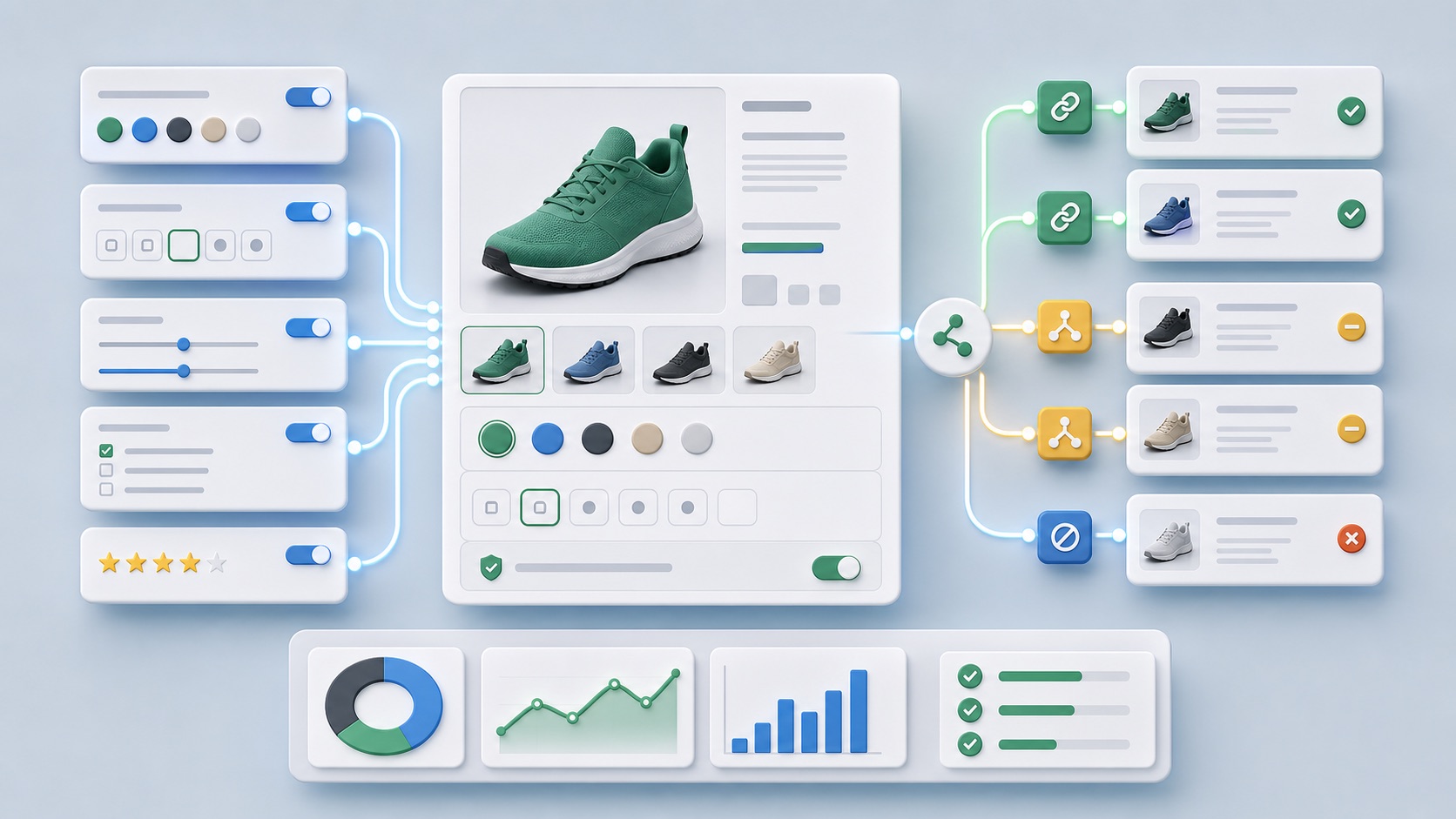
 AI-generated illustration
Product variants and SEO: Clean control of sizes, colors and filtersIndexing, Canonicals and User Leadership for Online Stores
Handle product variants SEO-safely: correctly control colors, sizes, parameters, canonicals, structured data, internal links and shop filters.
Product variants need clear rules: Some variants deserve their own visibility, others should be dug or canonized technically clean.
Classification and SEO relevance
The article helps shop teams plan variant logic, SEO and user experience together.
Online stores quickly generate many URLs for colors, sizes, materials, bundles and parameters. Without a set of rules, duplicate content, false canonicals, weak product data or pages are created that users need, but search engines should not index.
Control Case: Color Changes Price and Availability
A shoe is available in red, sold out in blue. Check which variant has its own URL and whether Selection, Canonical, visible information and product data describe the same variant. Test both the direct entry and the change in the browser.
An own URL is not automatically an independent search destination page. Decide on the basis of supply and demand which variants should be indexable; derive consistent internal links and sitemap entries from them.
Recommended approach
- Categorize variants according to search demand, user needs and distinguishability.
- Define rules for indexable variants, canonicals, and parameters.
- Ensure that product data, images, pricing and availability are consistent.
- Link important variants from categories, product pages, and internal searches.
- Monitor indexing, duplicate content, and revenue impact per rule group.
Typical errors
- Make all variants flat-rate indexable
- canonize all variants flat-rate on the main product
- Product data and structured data output inconsistently per variant
- Show unavailable variants without clear user guidance
- Optimize filter and variant logic separately from each other
Practice checklist
- Which variants have their own search demand?
- Are canonicals consciously set for each variant type?
- Are structured data for price and availability correct?
- Are there own pictures and content for important variants?
- How are sold-out variants treated?
- Are filter pages and variant rules coordinated?
How to identify improvements
- Indexed variant URLs
- organic entry to variants
- Duplicate content signals
- Revenue and conversion per variant group
- Crawl share of parameter URLs
Related Articles and Next Meaningful Steps
Frequent questions
Should each color have its own URL?
Only if users search for it, the variant is relevant different and the page offers inherent added value.
Are Canonicals the solution for all variants?
No. Canonicals help with duplicates, but do not replace a strategic visibility decision.
What about sold-out variants?
In the short term, they can be preserved; in the long term, they need clear alternatives, status or availability rules.
Conclusion
Document a variant rule per product type. This prevents frontend, structured data and indexing control from representing different products.